 how-to
How Long Medical Skincare Takes to Show Results
Last Updated: October 30, 2026
Quick Summary
Most people see early changes in hydration and softness within 2 to 4 weeks, while clearer changes in texture and tone usually take 8 to 12 weeks. Deeper improvements in fine lines often need several months of steady use, since skin renews itself on a slow biological schedule. Medical skincare results depend on consistency and the specific concern being treated.
- Hydration and softness are often noticed within the first 2 to 4 weeks.
- Texture and tone commonly become visible around 8 to 12 weeks.
- Fine lines and deeper concerns typically need several months of consistent use.
- Adult skin renewal takes roughly four weeks, so give each product at least one full cycle.
- Introduce one new product at a time and use sunscreen daily.
Table of Contents
- How Long Medical Skincare Results Typically Take
- Why Skin Renewal Cycles Set the Pace
- Medical-Grade Skincare Results Timeline by Concern
- How Often to Use Medical-Grade Skincare for Best Results
- How to Introduce Products and Manage Irritation
- How to Track Skincare Progress Objectively
- Medical-Grade Skincare Before and After: What Realistic Change Looks Like
- Booking Your First Skin Assessment at House of D
- Frequently Asked Questions
How Long Medical Skincare Results Typically Take
How long for medical skincare results to show? Most people see early changes in hydration and softness within 2 to 4 weeks. Clearer, more visible changes in texture and tone usually take 8 to 12 weeks. Deeper improvements in fine lines often need several months of steady use.
Many people expect faster results than skin can deliver. That gap is where most frustration starts. Medical-grade products are formulated with stronger active ingredients, but skin still follows its own biological schedule.
Early improvements feel encouraging, but the most meaningful changes tend to appear after several months. Knowing this timeline before starting makes it easier to stick with a routine.
- Hydration and softness: often noticed within weeks
- Texture and tone: commonly visible around 8 to 12 weeks
- Fine lines and deeper concerns: typically need several months
Why Skin Renewal Cycles Set the Pace
The skin renewal cycle is the main reason results take time. New skin cells form in the deeper layers and slowly move to the surface. In adults, this process takes roughly four weeks, and it tends to slow with age (pubmed.ncbi.nlm.nih.gov).
Each renewal cycle gives active ingredients a chance to work. Visible improvement often depends on how many cycles the skin completes while the routine stays consistent.
Consistency matters more than intensity. Skipping days or switching products constantly can reset progress, because the skin never completes the cycles it needs.
Medical-Grade Skincare Results Timeline by Concern
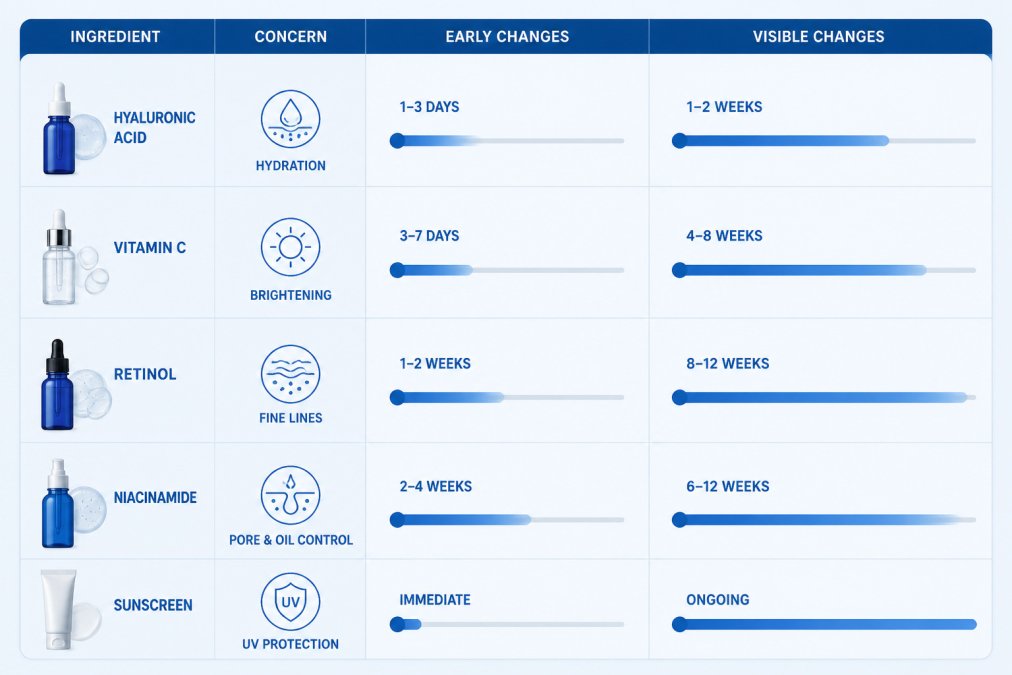
Different concerns respond on different schedules, and the active ingredient doing the work matters as much as the concern itself. A surface issue like dryness may improve quickly, while a pigment or wrinkle concern takes longer. The table below pairs common concerns with the ingredient families typically used for them and the timeline most practitioners associate with each. Treat these as general expectations, not guarantees, individual results depend on skin type, severity, adherence, and sun exposure.
| Concern | Typical active ingredients | Early changes | More visible change |
|---|---|---|---|
| Hydration, softness, radiance | Hyaluronic acid, glycerin, ceramides, niacinamide | 1-4 weeks | 8-12 weeks |
| Acne and surface oiliness | Salicylic acid, benzoyl peroxide, adapalene, azelaic acid | 4-6 weeks (with possible purge) | 8-12 weeks, often longer for inflammatory acne |
| Texture and clogged pores | Retinoids, exfoliating acids (AHA/BHA) | 4-8 weeks | 12-16 weeks |
| Discoloration and uneven tone | Vitamin C, azelaic acid, tranexamic acid, retinoids, hydroquinone (prescription) | 6-8 weeks | 12-24 weeks |
| Fine lines and early aging | Retinoids, peptides, vitamin C | 8-12 weeks | 16-24 weeks and beyond |
Hydration, Softness, and Radiance
Hydration is usually the fastest change people notice. Humectants like hyaluronic acid and glycerin draw water into the upper layers, while ceramides support the skin barrier. Skin may feel smoother and look more even within the first few weeks. A healthy glow often follows as the skin holds moisture better.
- First 2 to 4 weeks: skin feels softer and less tight
- 8 to 12 weeks: radiance and overall skin appearance look more consistent
Acne, Blemishes, and Surface Oiliness
Blemish and oiliness results depend heavily on the cause of the breakouts. Salicylic acid and benzoyl peroxide can begin reducing surface oil and clogged pores within a few weeks, but calmer, clearer skin often takes several months. Retinoids such as adapalene work more slowly but address the follicle over the long term. Breakouts can also appear temporarily as the skin adjusts, a pattern sometimes called purging, which is normal for some actives.
Anyone with persistent or painful acne should speak with a qualified professional rather than relying on a timeline alone (the NHS).
Fine Lines and Early Signs of Aging
Fine lines change slowly. Retinoids are among the most studied ingredients for this concern, and many people notice softer lines after several months of consistent use, though the change is often gradual (Topical tretinoin for treating photoaging). Peptides and vitamin C can support collagen and protect against daily damage, but results from a single product rarely show up in a few weeks.
Early-stage lines often respond better than deeper ones. Starting a routine before lines become deep can make the process more noticeable over time.
How Often to Use Medical-Grade Skincare for Best Results
Most routines work best when applied daily as directed. Missing applications regularly slows progress because the skin never builds a steady response.
Pricing depends on the products and plan chosen. For current pricing and recommended schedules, contact House of D, LLC for a personal quote. A clear breakdown of what medical skincare costs over time can help you weigh how often to invest.
- Use products daily, following the instructions provided
- Avoid starting several new actives at the same time
- Schedule periodic check-ins to adjust the plan as needed
How to Introduce Products and Manage Irritation
Starting too many products at once is one of the most common mistakes. When irritation shows up, it becomes hard to tell which product caused it. Adding one product at a time makes changes easier to track.
Mild dryness, redness, or peeling can happen during the first few weeks. These reactions often settle as the skin adjusts. Stronger or lasting irritation is a reason to pause the product and talk with a professional. Between treatments, seven daily steps for maintaining healthy skin show how to keep skin steady.
A simple approach works well:
- Introduce one new product at a time
- Wait at least 1 to 2 weeks before adding another
- Use sunscreen daily, since many active ingredients increase sun sensitivity
- Stop and seek advice if irritation becomes painful or severe
How to Track Skincare Progress Objectively
Memory is unreliable when it comes to skin changes. Small improvements are easy to miss day to day, and bad lighting or a poor night's sleep can make skin look worse than it is. A simple, repeatable tracking method makes results easier to judge and gives you concrete information to share at follow-up visits.
A Simple Photo and Symptom Log
- Pick a fixed checkpoint. Take photos on the same day each month, ideally in the morning before applying products.
- Control the conditions. Use the same window, the same phone or camera, the same distance, and the same angle. Avoid direct sunlight and overhead shadows.
- Capture the same views. A straight-on face shot, plus close-ups of any specific concern (cheek, forehead, chin).
- Log symptoms weekly. Note breakouts, dryness, redness, peeling, stinging, or oiliness on a simple 1-5 scale. A phone note or notebook works fine.
- Note routine changes. Record when you started or stopped a product so you can connect changes to results or irritation.
Realistic Checkpoints
- Week 2-4: Expect hydration and softness changes. Don't judge texture or tone yet.
- Week 8-12: Compare photos side by side. This is when most texture, clarity, and tone changes become visible.
- Week 16-24: Evaluate fine lines and discoloration. These concerns need multiple skin cycles.
Comparing photos taken 8 to 12 weeks apart usually shows clearer change than daily observation. Day-to-day variation is normal and is not a sign that a product is failing, look at the trend across checkpoints, not a single bad skin day.
Medical-Grade Skincare Before and After: What Realistic Change Looks Like
Realistic results are usually subtle. Skin may look more even, feel softer, and appear brighter. Dramatic overnight transformations are not typical for medical-grade care, and claims that promise them deserve skepticism.
Individual results vary based on skin type, age, lifestyle, sun exposure, and consistency. Two people using the same product can see different timelines. That variation is normal.
Before-and-after photos are most useful when they cover several months and show the same angle and lighting. Ask any provider for context about the results shown.
Booking Your First Skin Assessment at House of D
A skin assessment with a qualified professional is a sensible first step. A consultation can help identify which concerns matter most and whether a medical-grade routine fits your goals.
To learn what an assessment includes and to ask about current pricing, contact House of D, LLC directly.
Before starting any new treatment, consider speaking with a qualified professional about your individual health and skin history.
Frequently Asked Questions
Does medical-grade skincare actually work?
Medical-grade skincare products are formulated with higher concentrations of active ingredients than many over-the-counter options, and they are often used under professional guidance. Results depend on the concern, the ingredients, and how consistently the routine is followed. Early improvements in hydration and texture may appear within a few weeks, while changes to fine lines or pigmentation generally take longer, often 8 to 12 weeks or more. Individual results vary, so a consultation with a qualified professional can help set realistic expectations for your skin.
How long does medical-grade skincare take to show results?
Many people notice initial improvements in softness, hydration, and radiance within 2 to 4 weeks, which roughly reflects the time it takes for the skin to go through part of its renewal cycle. More visible changes to texture, tone, and fine lines often appear around 8 to 12 weeks, and some concerns may take 16 to 20 weeks or longer to assess fully. Consistent use is the most important factor, and results can vary based on skin type, concern, and routine.
How often should I use medical-grade skincare?
Frequency depends on the specific products and your skin's tolerance. Some formulas are used once daily, while others, such as stronger active ingredients, may be introduced gradually, starting two or three times per week. Your provider can recommend a schedule based on your concerns. Using products as directed and avoiding overuse helps reduce irritation and gives the skin time to respond.
What should I do if my skin gets irritated after starting a new product?
Mild dryness, redness, or tingling can occur during the first few weeks as skin adjusts to active ingredients. Reduce how often you apply the product, use a gentle moisturizer, and avoid combining several new actives at once. If irritation is intense, persistent, or includes swelling or blistering, stop using the product and contact a qualified professional. Describing your symptoms during a consultation helps determine whether adjustments are needed.