 listicle
Which Anti-Aging Treatments Work Best in Your 40s?
Last Updated: October 29, 2026
Quick Summary
The most effective anti-aging treatments in your 40s start with a daily sunscreen and a retinoid, which build collagen and speed cell turnover over months. Professional options like neuromodulators, dermal fillers, biostimulators, lasers and peels target specific concerns such as expression lines, volume loss and uneven tone.
- Daily sunscreen is non-negotiable, because new sun damage can undo retinoid gains.
- Retinoids work over months, so start at a lower strength and use them a few nights a week.
- Neuromodulators soften expression lines, but effects generally fade over roughly three to four months.
- Hyaluronic acid fillers restore volume, and results commonly last six months to about two years.
- Book a consultation to choose a treatment sequence matched to your concerns and skin tone.
Table of Contents
- Why Your Skin Changes in Your 40s
- Best Topical Options: Retinoids and Daily Skincare
- Best Professional Treatments for Expression Lines and Volume
- Laser, Light and Peel Options for Tone and Texture
- How Often to Get a Facial in Your 40s
- Building a Skincare Routine That Supports Treatments
- Booking Your Consultation to Choose Your Treatment Sequence
- Frequently Asked Questions
Your 40s are when skin starts changing in ways that are hard to ignore. Learn how young professionals work to prevent skin aging before those changes become visible.
American Academy of Dermatology guidance on skin aging is a useful starting point, because the core message is consistent: prevention and sun protection matter as much as any treatment you add later.
Why Your Skin Changes in Your 40s
Collagen production declines gradually with age, and cell turnover slows. Over time that combination shows up as looser texture, deeper lines, and dullness. Sun exposure accelerates all of it.
Fine Lines, Sun Damage and Uneven Tone
Fine lines in your 40s often reflect years of repeated expression combined with sun exposure. Age spots and uneven tone usually trace back to the same sun history. Most people notice these concerns first in the mirror under bright light.
Collagen Loss, Firmness and Volume
Volume loss in the cheeks and temples makes the face look flatter and can deepen the folds around the mouth. Firmness changes more slowly, so treatments that target collagen tend to work best when started before the changes become pronounced.
Best Topical Options: Retinoids and Daily Skincare
Topical treatments are the foundation most dermatologists recommend. Find out which medical-grade skincare options for wrinkles actually work. Retinoids are the best-studied category of anti-aging treatments for fine lines.
A practical approach is to start with a lower strength, use it a few nights a week, and build up slowly. Get natural daily steps to maintain youthful skin that complement these treatments.
Daily sunscreen is non-negotiable. Without it, the gains from retinoids are easily undone by new sun damage.
The article's topical recommendations come down to a few practical points, summarised below.
| Topical step | Key guidance | Why it matters |
|---|---|---|
| Retinoids | Start low, use a few nights a week | Irritation is the top reason people quit |
| Retinoid results | Take months, not days | Collagen and turnover change slowly |
| Daily sunscreen | Use every day | Protects gains from retinoids |
Best Professional Treatments for Expression Lines and Volume
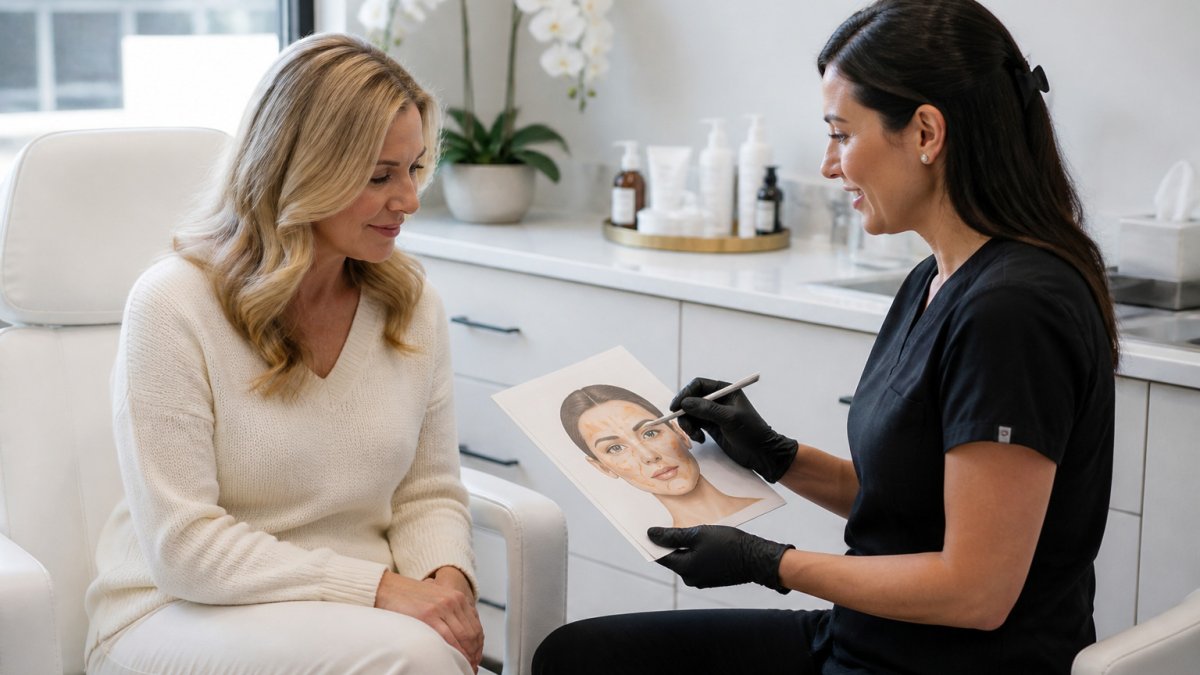
Professional injectable options fall into three broad groups, and they are not interchangeable. See how to choose the right rejuvenation treatment for mature skin based on your specific concerns. Understanding what each one does, and what it cannot do, is the difference between a realistic plan and an expensive disappointment.
Neuromodulators for Dynamic Expression Lines
Botulinum toxin products temporarily relax the small facial muscles that create dynamic lines, the crow's feet that appear when you squint, the horizontal forehead lines when you raise your brows, and the vertical "11" lines between the brows. The mechanism is straightforward: the product blocks the nerve signal that tells the muscle to contract, so the overlying skin stops creasing.
- Realistic outcome: Softening of dynamic lines, with the best results in people whose lines are still mostly expression-driven. Deep static folds will not disappear.
- Duration and maintenance: Effects generally fade over roughly three to four months, so this is a recurring cost, not a one-time fix.
- Safety and candidacy: Common effects include temporary bruising, mild headache, and, less often, heaviness or drooping of the brow or eyelid. People who are pregnant or breastfeeding, or who have certain neuromuscular conditions, are generally not candidates. Provider technique and product selection matter enormously.
Dermal Fillers for Volume Loss
Hyaluronic acid fillers restore volume in the cheeks, temples, and around the mouth, and can soften folds such as the nasolabial lines. Hyaluronic acid is a substance the skin already contains, and these fillers are gradually broken down by the body (the FDA).
- Realistic outcome: Restored volume and improved contour, with results that depend heavily on the provider's assessment of facial anatomy. Overfilling is a common reason results look unnatural.
- Duration and maintenance: Results commonly last somewhere in the range of six months to about two years depending on the product, the treatment area, and individual metabolism. Maintenance sessions are the norm.
- Safety and candidacy: Risks include bruising, swelling, lumps, and, rarely but seriously, vascular occlusion, where filler blocks a blood vessel. This is why treatment should be performed by a clinician trained to recognize and manage complications, and why anyone with a history of severe allergic reactions or certain autoimmune concerns should be assessed first.
Biostimulators for Collagen Support
Biostimulators such as poly-L-lactic acid and calcium hydroxylapatite products work differently from hyaluronic acid fillers. Rather than simply adding volume, they prompt the body to build collagen over time, so results develop gradually over weeks to months rather than appearing immediately. They are often used for broader facial volume loss and skin quality rather than for isolated folds.
- Realistic outcome: Gradual improvement in firmness and volume, with results that build over a series of sessions. This is not a quick fix, and patience is required.
- Duration and maintenance: Results can last longer than hyaluronic acid fillers, often a year or more, but the treatment is typically delivered across multiple sessions spaced weeks apart.
- Safety and candidacy: Nodules and lumps are a known risk, particularly with improper technique or placement. As with all injectables, provider experience is the single biggest factor in safety and outcome.
Comparing the Three Realistically
The honest comparison is not "which is best" but "which matches the concern." Neuromodulators address movement; fillers address volume; biostimulators address collagen and skin quality over time. Many people in their 40s combine a neuromodulator for expression lines with a filler or biostimulator for volume, and the sequencing and spacing between them should be planned with a clinician rather than booked piecemeal.
Pricing depends on product, the amount needed, the treatment area, and the provider's credentials. For current pricing, contact House of D, LLC for a quote after a consultation.
Laser, Light and Peel Options for Tone and Texture
Sun damage, uneven tone, and rough texture are where energy-based and exfoliating treatments earn their place. But "laser" and "peel" are broad labels covering very different intensities, recovery times, and risk profiles. Matching the treatment to your skin tone and your tolerance for downtime matters more than the brand name on the device.
Laser and Light-Based Rejuvenation
These treatments deliver controlled energy to the skin to target pigment, redness, and texture, and to stimulate collagen remodeling. They range from gentle, no-downtime options to ablative resurfacing with a week or more of recovery.
- Intense pulsed light (IPL): Intense pulsed light devices use broad-spectrum light to target sun spots, redness, and uneven tone. IPL is not a laser and is generally gentler, with little to no downtime for many people. It typically requires a series of sessions, and results are gradual. It is best suited to lighter skin tones; darker skin tones carry a higher risk of pigment changes and should be assessed carefully.
- Non-ablative fractional lasers: These create microscopic columns of injury in the skin to trigger collagen production without removing the surface. Downtime is usually a few days of redness and mild swelling, and a series of sessions is often recommended. Results are gradual and modest compared with ablative options.
- Ablative fractional resurfacing: This removes the outer layer of skin and can produce more dramatic improvement in texture and sun damage, but recovery commonly involves a week or more of significant redness and peeling, and the risk profile is higher. It is generally reserved for appropriate candidates after a careful assessment.
Chemical Peels
Chemical peels apply an acid solution, commonly glycolic, salicylic, lactic, or trichloroacetic acid (TCA), to exfoliate the skin and stimulate turnover. They are generally the lowest-cost professional option for tone and texture, and depth determines both results and recovery.
- Superficial peels: Little to no downtime, often a series of sessions spaced a few weeks apart. Good for dullness, mild uneven tone, and congestion.
- Medium-depth peels: More noticeable peeling and redness for several days, with more meaningful improvement in pigmentation and texture. A series may still be needed.
- Deep peels: Reserved for specific concerns and appropriate candidates, with significant recovery and higher risk. These are not routine treatments and require careful clinician assessment.
Peels carry risks of irritation, post-inflammatory hyperpigmentation (again, more common in darker skin tones), and, with deeper peels, scarring. Sun protection during and after the peel series is essential, because fresh, healing skin is more vulnerable to new sun damage.
Microneedling and Collagen-Stimulating Procedures
Microneedling creates controlled micro-injuries to prompt collagen production, and it is often combined with radiofrequency (as in some fractional radiofrequency devices) to add a tightening effect. Downtime is typically a few days of redness, and a series of sessions is standard. It is generally considered to have a favorable safety profile across skin tones, though it is not appropriate during active breakouts or infection, and results are gradual.
Comparing Realistically
The strength of evidence and the likely degree of improvement vary considerably. Superficial peels and IPL offer modest, gradual improvement with low downtime; non-ablative lasers offer more with a few days of recovery; ablative resurfacing offers the most dramatic change but with the most downtime and risk.
Pricing depends on the device, the treatment area, the number of sessions, and the provider's credentials, so contact House of D, LLC for a current quote after an assessment.
How Often to Get a Facial in Your 40s
Professional facials support the at-home routine rather than replacing it. Compare a medical spa with a traditional facial spa to see which fits your needs. Many people book one every four to six weeks, but frequency should match your skin's needs and your treatment plan.
Watch out: scheduling a peel or laser session too soon after another active treatment can irritate the skin and blunt results.
Building a Skincare Routine That Supports Treatments
A solid routine makes professional results last longer. Start with a gentle cleanser, add a retinoid at night, and apply sunscreen every morning. Hydration matters, since dry skin shows fine lines more clearly. Vitamin C in the morning can help with tone and antioxidant protection.
Check with your provider about whether to pause new active ingredients before and after a professional treatment.
Booking Your Consultation to Choose Your Treatment Sequence
The right order of treatments depends on your skin type, tone, concerns, and budget. Some people start with topicals and add procedures later. Others combine a neuromodulator for expression lines with a laser or peel for texture.
At House of D, LLC, our team reviews your goals and skin history before recommending anything. Use the consultation to ask about risks, recovery time, and what results realistically look like at your age.
Frequently Asked Questions
How do I look younger in my 40s?
Most of the visible change in the 40s comes from sun damage, slower collagen production and volume loss, so the most effective approach combines daily sun protection, a consistent retinoid or other topical routine, and, where appropriate, professional treatments chosen with a qualified provider. Results from topical products usually take several months to appear, and in-office treatments vary in downtime and longevity. A provider can assess which concerns matter most for your skin and suggest a sequence. Avoid expecting any single product to reverse years of sun exposure.
How often should a 40-year-old woman get a facial?
Many people in their 40s schedule a professional facial every four to six weeks, since that interval matches the skin's natural renewal cycle and allows gradual maintenance. The right frequency depends on your skin type, the treatments you are combining, and any irritation you notice. Ask your provider whether to space facials farther apart if you are using a retinoid or having chemical peels, because both can increase sensitivity. Your provider can set a schedule that fits your budget and goals.
Are retinoids or vitamin C better for aging skin?
Retinoids have the strongest evidence for reducing fine lines and improving texture, while vitamin C serums are often used in the morning for antioxidant support and to help with uneven tone. Many people use both, applying vitamin C in the morning and a retinoid at night. Retinoids can cause dryness and peeling at first, so start slowly and use sunscreen daily. A dermatologist or qualified skincare professional can help you choose the strength and combination that suits your skin.
What is the best serum for aging skin?
The best serum depends on your concerns and tolerance. Retinol and retinoid serums address fine lines and texture, vitamin C serums support tone and antioxidant protection, and peptide or hyaluronic acid serums add hydration. Look for fragrance-free formulas if your skin is sensitive, and introduce one new active at a time so you can tell what your skin tolerates. Specific product recommendations should come from a consultation rather than a generic list.